Ayò Ọlọ́pọ́n (also called Ayò) belongs to the family of traditional board games and is very popular amongst the Yorùbá people in the South Western part of Nigeria. It is important to mention that Ayò Ọlọ́pọ́n is also played by some other tribes in Nigeria as well as in other countries, though with different names. The game plays a key role in enhancing social interaction and fostering community bonding amongst the Yorùbá people.
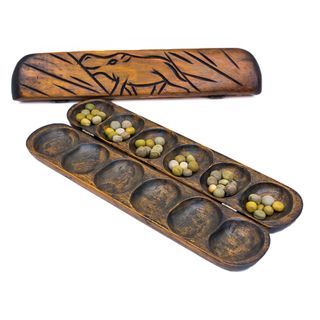
Ayò Ọlọ́pọ́n game board is carved out of wood and contains 12 holes, six on either sides of the board. There are 48 seeds i.e., ayò, used for playing the game. Specifically, at the beginning of the game, there would be 4 seeds in each hole. Ayò is played by two players, with each assigned one side of the board (i.e., six holes in a row). The players take turns to play the game by transiting the seeds from one hole to the next, and taking possession of each other’s seeds whenever possible, based on the standard rule of the game. After several turns, a winner emerges when one player takes possession of all the other player’s seeds. Another scenario for deciding the winner is also when one player obtains more than 24 seeds (i.e., more than half of the total seeds).

Besides social interaction, building healthy competition and the general entertainment that it brings to the players, playing Ayò Ọlọ́pọ́n also contributes towards the players’ logical reasoning, cognitive development, analytic mindset and ability to think and plan strategically. Hence, serving as a very good mental exercise for the players of the game.
As “greetings” is very customary with the Yorùbás, there is also a particular type of greeting associated with the playing of the Ayò game. While the game is going on, passers-by and spectators will often greet the players by saying “Mo ki ọ̀ta, mo ki òpè” (translated as “I greet the winning side and I greet the losing side”), “ọ̀ta” being the winner/winning player and “òpè” being the loser/losing player). Generally, winning the Ayò game involves a lot of patience and perseverance, based on the time required to think and plan the strategies for winning the game. The Yorùbá saying “onísùúrù ni í jogun ayé” (i.e., the patient one inherits the world) further buttresses this point. Therefore, playing the Ayò Ọlọ́pọ́n game not only enhances cognitive abilities but also helps to instill moral values.
 Yorubas in Pirkanmaa